 |
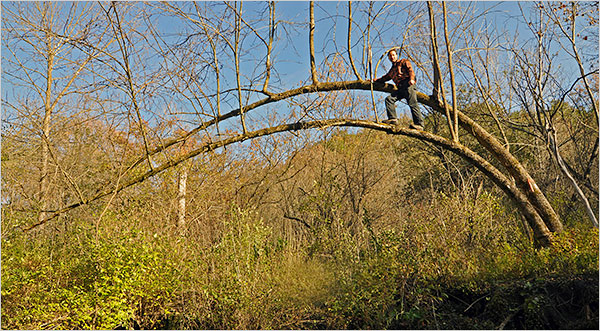
ROALD GUNDERSEN, an architect who may revolutionize the building industry, shinnied up a slender white ash near his house here on a recent afternoon, hoisting himself higher and higher until the limber trunk began to bend slowly toward the forest floor.
“Look at Papa!” his life and business partner, Amelia Baxter, 31, called to their 3-year-old daughter, Estella, who was crouching in the leaves, reaching for a mushroom. Their son, Cameron, 9 months, was nestled in a sling across Ms. Baxter’s chest.
Wild mushrooms and watercress are among the treasures of this 134-acre forest, but its greatest resource is its small-diameter trees — thousands like the one Mr. Gundersen, 49, was hugging like a monkey.
“Whooh!” he said, jumping to the ground and gingerly rubbing his back. “This isn’t as easy as it used to be. But see how the tree holds the memory of the weight?”
The ash, no more than five inches thick, was still bent toward the ground. Mr. Gundersen will continue to work on it, bending and pruning it over the next few years in this forest which lies about 10 miles east of the Mississippi River and 150 miles northwest of Madison.
Loggers pass over such trees because they are too small to mill, but this forester-architect, who founded Gundersen Design in 1991 and built his first house here two years later, has made a career of working with them.
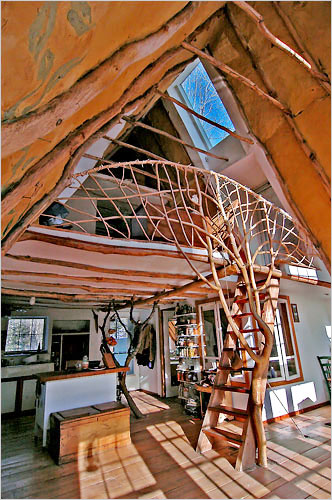 “Curves are stronger than straight lines,” he explained. “A single arch supporting a roof can laterally brace the building in all directions.” “Curves are stronger than straight lines,” he explained. “A single arch supporting a roof can laterally brace the building in all directions.”
The firm, recently renamed Whole Tree Architecture and Construction, is also owned by Ms. Baxter, a onetime urban farmer and community organizer with a knack for administration and fundraising. She also manages a community forest project modeled after a community-supported agriculture project, in which paying members harvest sustainable riches like mushrooms, firewood and watercress from these woods, and those who want to build a house can select from about 1,000 trees, inventoried according to species, size and shape, and located with global positioning system coordinates, a living inventory that was paid for with a $150,000 grant from the United States Department of Agriculture.
According to research by the Forest Products Laboratory in Madison, run by the USDA, a whole, unmilled tree can support 50 percent more weight than the largest piece of lumber milled from the same tree. So Mr. Gundersen uses small-diameter trees as rafters and framing in his airy structures, and big trees felled by wind, disease or insects as powerful columns and curving beams.
Taking small trees from a crowded stand in the forest is much like thinning carrots in a row: the remaining plants get more light, air and nutrients. Carrots grow longer and straighter; trees get bigger and healthier.
And when the trees are left whole, they sequester carbon. “For every ton of wood, a ton and a half of carbon dioxide is locked up,” he said, whereas producing a ton of steel releases two to five tons of carbon. So the more whole wood is used in place of steel, the less carbon is pumped into the air.
These passive solar structures also need very little or no supplemental heat.
Tom Spaulding, the executive director of Angelic Organics Learning Center, near Rockford, Ill., northwest of Chicago, knows about this because he commissioned Mr. Gundersen to build a 1,600-square-foot training center in 2003. He said: “In the middle of winter, on a 20-below day, we’re in shorts, with the windows and doors open. And we don’t burn a bit of petroleum.”
“It’s eminently more frugal and sustainable than milling trees,” he added. “These are weed trees, so when you take them out, you improve the forest stand and get a building out of it. You haven’t stripped an entire hillside out west to build it, or used a lot of oil to transport the lumber.” |
Mr. Gundersen had a rough feeling for all of this 16 years ago, when he started building a simple A-frame house here for his first wife and their son, Ian, now 15. He wanted to encourage local farmers to use materials like wood and straw from their own farms to build low-cost, energy-efficient structures. So he used small aspens that were crowding out young oaks nearby.
“I would just carry them home and peel them,” said Mr. Gundersen, who later realized he could peel them while they were standing, making them “a lot lighter to haul and not so dangerous to fell.”
Mr. Gundersen, who built most of the house singlehandedly, also recognized the beauty of large trees downed by disease or wind, and used the peeled trunks, shorn of their central branches a few feet from the crook, as supporting columns in the house. “I thought they were beautiful, but I didn’t think how strong they were,” he said.
"In architecture, how materials come together and how they are connected is really the god in the details," he continued."The connection is where things will fall apart," he said, adding that the crook of a tree"has been time-tested by environmental conditions for 200 million years."
He refers to that first house -- which cost $15,000 (for plumbing, electrical, septic and other basic amenities, as well as $4,000 in paid labor) and a year of his own labor -- as his master’s degree in architecture. Divorced in 1997, he now lives there with Ms. Baxter and their two children.
After finishing the A-frame, Mr. Gundersen built a 100-by-20-foot solar greenhouse next door with thick straw-bale walls on three sides, banked into the north slope. He used small-diameter, rot-resistant black locust trees for the timber framing. |
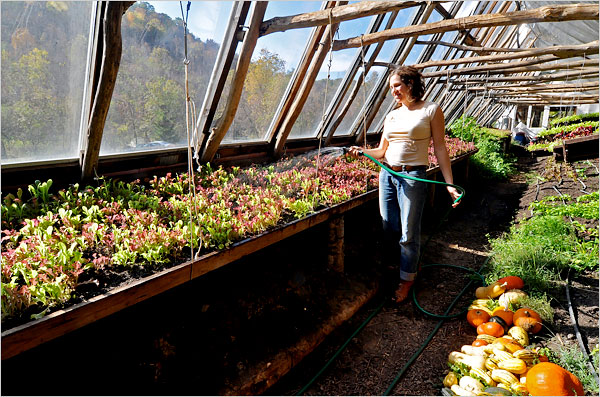 |
A wall of double-paned glass, positioned to optimize the low-angle winter light, faces south. Growing beds angled slightly toward the sun are planted with rows of mustard greens, kale, chard, arugula, lettuces and herbs. Hanging trays of micro-greens and a fig and bay tree promise fresh food for the fall and winter.
But it is the Book End -- the little house attached to the greenhouse, which is home to the firm’s project manager and his wife -- that quietly vibrates with the spirit of the forest.
"We used a lot of standing dead elm here," Mr. Gundersen said, pointing out the delicate trails, or galleries, left by the beetles that killed the tree. Peeled of their bark and satiny smooth, these trees have a presence that seems to draw one’s arm around their trunks and invite a viewer to lean into them, to soak up strength from these powerful old souls.
In this quiet farming community, where people may not have a lot of money to spend, but do have plenty of wood and straw, word of the beauty and practicality of Mr. Gundersen’s structures has spread. Solar greenhouses made of local materials can extend the growing season through winter, even in a place where temperatures can drop to 30 or 40 below. In the last 18 years, Whole Trees has built 25 of them here.
It’s part of a vision Mr. Gundersen developed after spending three years as a project architect on Biosphere 2, the three-acre glass-enclosed miniature world constructed near Tucson in the 1980s, which tried to replicate the earth’s systems, but foundered on carbon dioxide, acidic seas, failed crops and internal intrigues. After that experience, he wanted to build something more basic to human needs.
Mr. Gundersen grew up in nearby LaCrosse, where his Norwegian great-grandfather, a doctor, founded a local institution, the Gundersen Clinic; he comes from a clan of doctors and tree lovers."There are 23 doctors in the family," he said, including his father and uncle and four great-uncles, but he seems to be wired more like his great-grandmother Helga, whose family still owns a tree farm in Norway. He and his grandmother would often picnic on this piece of wild land, where he remembers picking watercress and wildflowers and building tree forts.
Now, to be in his buildings is to be among the trees. |
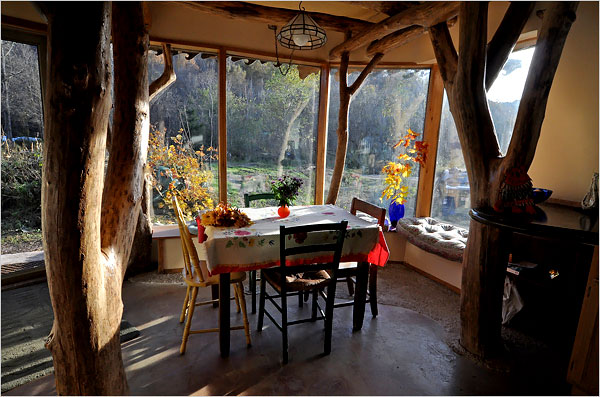 |
"It almost feels like we’re in a forest, the trees have such a presence," said Marcia Halligan, a client who is a farmer and Reiki instructor, standing among the birch posts of her airy bedroom.
She and her partner, Steven Adams, who grows seed for organic seed companies, worked with Mr. Gundersen on a design that uses 22 different kinds of wood, most of it from their own land outside Viroqua, southeast of Stoddard.
The economic downturn has put commissions for several large buildings for nonprofits and a 4,600-square-foot residence on hold, Mr. Gundersen and Ms. Baxter say, but the demand for small houses like theirs is up.
"It’s remarkable how many people have called this last year asking for 1,000-square-foot houses," Ms. Baxter said."People are downsizing for their retirement homes, and even younger folks are thinking about energy costs, environmental awareness and simplicity."
Whole Trees can keep construction costs as low as $100 a square foot, not including site preparation, if the client is willing to shop for secondhand fixtures and the like.
As people begin to see forests as a resource, they may begin to take care of them rather than cutting them down to make room for cornfields or pastures. And the forests keep giving back.
"I’ve taken 20 trees per year off one acre, for 12 buildings," Mr. Gundersen said."You can never tell that we’ve taken out that much wood." |

